- Today's Ajenda
- Posts
- TODAY'S AJENDA #102
TODAY'S AJENDA #102
Anniversary Edition: What the last year taught us about health, tech & trust

Today's Ajenda:
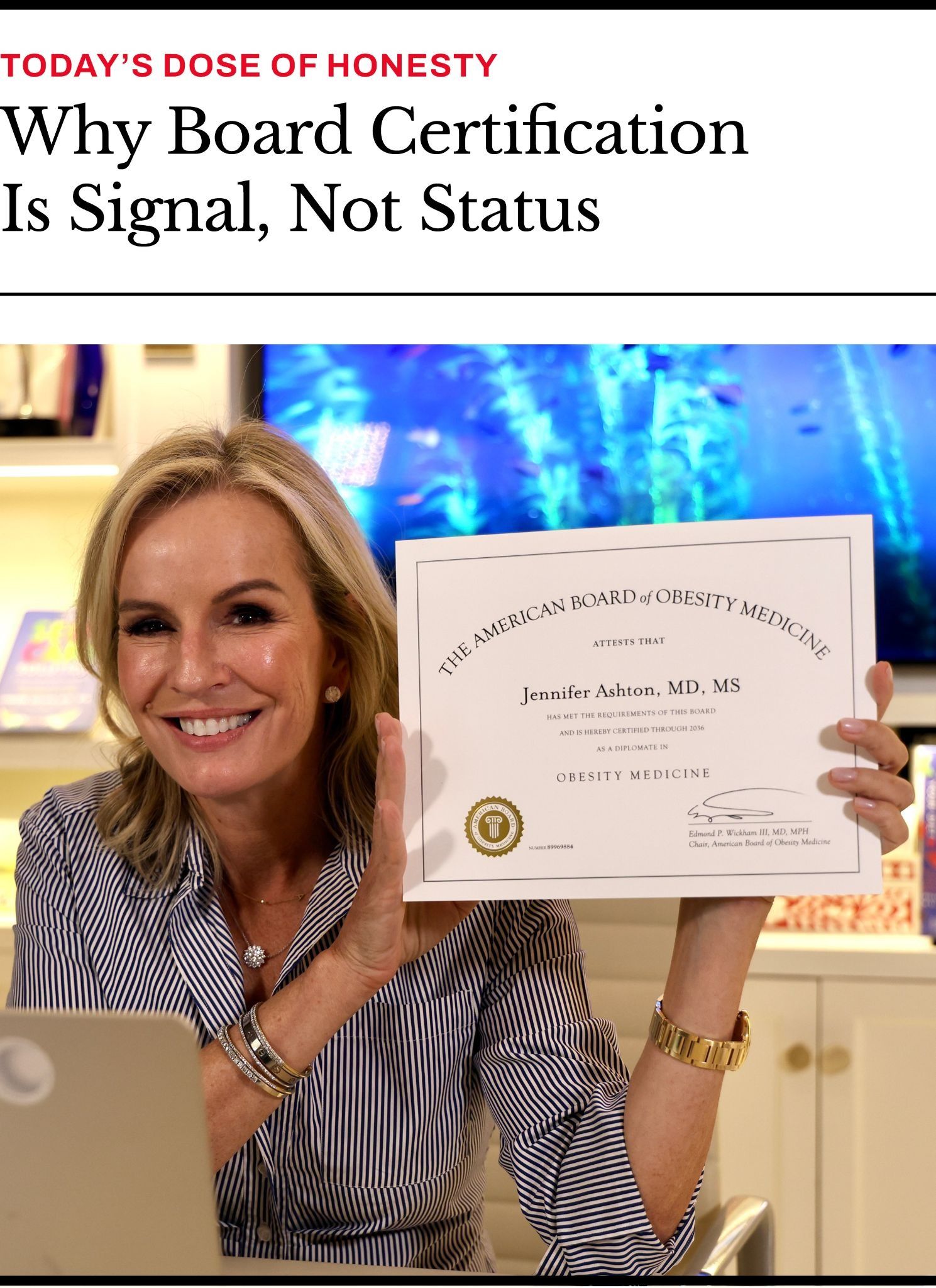
I just sat for a five-hour Obesity Medicine board certification exam consisting of two hundred questions covering surgery, pediatrics, genetics, pharmacology, bariatrics, endocrinology, and behavioral science; essentially the full spectrum of how metabolism functions in real human bodies across the lifespan. I didn’t re-certify because I love exams or because I wanted to spend my evenings memorizing pathways and prescribing algorithms, nor is this topic cosmetic or trendy; I did it because recertification matters to the foundation of women’s health and to the discipline of medicine itself.
Obesity medicine sits at the intersection of nearly every issue women over fifty are navigating right now: heart disease, bone loss, insulin resistance, fatty liver, sarcopenia, GLP-1 medications, hormones, inflammation, and cognitive health, and these are not separate conversations but metabolically intertwined realities. When we talk about protecting your heart, preserving muscle, preventing fractures, supporting your brain, or deciding whether to use medication, we are talking about metabolism and the biological infrastructure of how bodies change over time.
Why Recertification Matters
There are just over 11,000 physicians in the United States and Canada who are board-certified in obesity medicine through the American Board of Obesity Medicine, which is surprisingly small given how many doctors, influencers, and public figures speak with confidence about diet, nutrition, GLP-1 medications, and weight management. The number feels even smaller when you remember that roughly 70% of American adults are living with overweight, obesity, or metabolic disease. If approximately 10,000 of those certified physicians are practicing in the United States, that works out to about one board-certified obesity medicine physician for every 23,000 people, which is not a trivial gap but a structural one that shapes who has access to deeply trained metabolic expertise.
The Noise Problem
At the same time, I recognize that you are not suffering from a shortage of voices.
If anything, you are drowning in them. Every day, there is a new podcast, a new protocol, a new supplement stack, a new headline about protein or fasting or muscle or longevity, and the burden quietly shifts to you to curate it all, to decide who is credible, who is extrapolating, who is selling, and who is actually accountable to the science. That kind of decision fatigue is real. It is exhausting to feel like you need to fact-check your health advice while also living your life.
Maintaining certification is not automatic or symbolic; it requires disciplined study, a rigorous examination, staying current with evolving science, and proving that you still know what you are talking about. In a landscape where visibility can be mistaken for expertise and confidence can sound indistinguishable from competence, this external verification matters because it offers you something steadier than volume or charisma. It offers you accountability.
Accountability vs Influence
We are living in a moment when enormous health platforms and large audiences do not necessarily come with formal board certification in the areas being discussed. Peter Attia has shaped much of the modern longevity conversation and has tremendous influence, yet he is not board-certified in a clinical specialty and never finished his residency. Casey Means has testified before the Senate Health, Education, Labor, and Pensions (HELP) Committee at her confirmation hearing and has influenced the national nutrition dialogue despite not completing residency training, never becoming board-certified, and not holding an active medical license. Having an M.D. after one’s name is not necessarily synonymous with being a credible, credentialed expert.
This does not mean they lack knowledge, perspective or that they have not contributed to the conversation, but it does mean that formal clinical specialization, supervised postgraduate training, and ongoing high-stakes examination are fundamentally different from influence and opinion. In an era where you are asked to sort through endless options, that distinction can be grounding. Pay attention to that.
For me, maintaining board certification is about accountability, both to the science and to you. It’s also about relieving you of the constant pressure to curate your own medical advisory board from the internet. When you ask me about the long-term use of GLP-1 medications, you are not asking a casual lifestyle question. When you wonder whether increasing protein will worsen your cholesterol profile, or whether starting hormone therapy at sixty-two is reasonable, or how to protect your bone density and cognitive health at the same time, you are not looking for a clever take that performs well on social media. These questions carry real risk and real consequences, as well as real benefit, which means they require nuance, familiarity with competing data and contraindications, awareness of long-term outcomes, and a firm grasp of the physiology that lies beneath the headlines. They demand clinical grounding, pattern recognition developed over years of patient care, and formal education that has been examined against an external standard.
Your ‘ask me anything’ questions make it unmistakably clear that you are looking for risk-aware, evidence-based guidance that respects the complexity of midlife medicine and treats you like an intelligent adult who can engage with that complexity without being overwhelmed by it.
So yes, I am proud I passed again! (I was first board-certified in obesity medicine in 2016!) Not because of the credential on paper, but because of what that renewal represents: a willingness to sit down, be examined, and be measured against a defined standard in a field that continues to evolve. It represents a commitment to staying sharp rather than coasting on past training, and an ongoing decision to keep earning your trust so that you do not have to wonder, with every new headline, whether the advice you are hearing is grounded or speculative.
In a world full of noise, I intend to remain accountable to the science so you know exactly where to turn for a signal.

The Ammortal Chamber, first unveiled commercially in 2023, arrived on the wellness scene with a sleek promise: one capsule that stacks multiple recovery and regenerative modalities into a single session. Think of it as a futuristic wellness pod combining vibroacoustic stimulation, photobiomodulation (red/near-infrared light), pulsed electromagnetic therapies, guided breathwork, and even inhaled molecular hydrogen all in a sensory-optimized environment.
Buzzworthy? Yes. Pricey? Very. Retail purchase price for clinics hovers around $160,000. But what’s real, what’s emerging, and what’s speculative? Especially for women over 50, where cost and evidence both matter, its merits are worth unpacking. Is it a waste or actually worth it?
The honest answer is: probably, there is no long-term data on this unique combination, but there is science on each of its modalities. Relaxation and novelty are not the same as proof of long-term health benefit, which is where the conversation needs to stay grounded.
Modality Breakdown: What We Actually Know
1. Vibroacoustic Therapy — Nervous System & Sleep
Pros: Early research links vibroacoustic stimulation to improved relaxation and reductions in stress markers. A 2024 study using sound-rich massage showed measurable stress relief (including increased parasympathetic activity via ECG), and broader sleep literature suggests acoustic interventions can help insomnia symptoms when consistently applied.
Cons: Contraindications include those with pacemakers or implanted electronic devices, active pregnancy (insufficient fetal safety data), and some practitioners caution against use with active inflammation or certain musculoskeletal conditions. Major limitations in published studies persist, with high demand for longitudinal, controlled experiments before clinical conclusions can be drawn.
Takeaway: Useful for stress and sleep when integrated thoughtfully over time…i.e., not just one session.
2. Photobiomodulation (PBM) — Light for Cells
PBM is the strongest science base in the chamber. Red/near-infrared light has been shown in clinical trials to support skin quality and reduce signs of aging. Systematic reviews find analgesic benefits for musculoskeletal pain and modulation of inflammation.
Pros: A 2025 umbrella review of RCTs found PBM significantly reduced pain intensity with moderate certainty of evidence. The safety profile is strong even in oncology contexts — current clinical and preclinical evidence suggests PBM is oncologically safe for skin rejuvenation, with no evidence it should be avoided by patients who have previously been treated for cancer.
Cons: When rigorously tested (e.g., for acute stroke), PBM went from appearing to work, to working only in subsets, to a trial being terminated for futility. Direct application over active tumor sites remains a precautionary contraindication.
Takeaway: The red/NIR component is evidence-anchored and can be a real tool for pain and recovery, but protocol standardization still matters and the evidence base for many claimed benefits is thinner than marketed.
3. PEMF / Electromagnetic Fields — Musculoskeletal Support
Pros: PEMF is considered a noninvasive, safe, and effective therapy, with numerous studies showing potential as a standalone or adjunctive treatment for musculoskeletal disorders, including osteoarthritis, osteoporosis, and fractures. Certain PEMF devices have received FDA clearance for specific indications, including bone healing and pain management. PEMF therapy seems to help reduce chronic low back pain, and the safety profile under medical supervision is generally well-documented.
Cons: No concrete scientific evidence supports dramatic pain reduction claims, and it is strongly recommended that more research and clinical investigations be conducted before recommending it broadly. Contraindications include pacemakers and other implanted electrical devices, pregnancy, active bleeding disorders, and potentially epilepsy.
Takeaway: Complementary, not standalone, and not a replacement for strength training or medical osteoporosis therapy.
4. Inhaled Molecular Hydrogen
Pros: The safety record is consistently clean across trials. A 2023 clinical review across 81 identified clinical trials and 64 scientific publications found positive indications across major disease areas, including cardiovascular diseases, cancer, respiratory diseases, and central nervous system disorders.
Cons: Administration poses real practical challenges — hydrogen's explosive hazard and low solubility require carefully engineered delivery systems, and these challenges haven't been fully resolved for consumer-grade devices.
Takeaway: Interesting, low-risk biology, but still-evolving studies make this worth watching, not worth overstating.
But context matters here:
Athlete endorsement is a marketing signal, not a clinical one. Pro athletes have notoriously high susceptibility to placebos. Their livelihoods depend on recovery, so anything they believe will help tends to do so (at least subjectively). The same pattern played out with cryotherapy, hyperbaric oxygen, and IV drips: all were widely adopted by elite athletes before the evidence base caught up (and, in some cases, never fully did).
The honest framing: Athlete adoption tells you the product has reached a credible, discerning user base willing to invest in marginal gains. That's worth noting. It does not tell you which of the four modalities is doing the work, whether the effect is real or placebo-driven, or whether the results would replicate in a controlled trial.
A Realistic Take for Women Over 50
Your biggest biological priorities after 50 are:
• Sleep quality
• Muscle preservation
• Bone health
• Inflammation control
• Stress physiology balance
What actually moves the needle most for women over 50, in rough order of evidence weight:
Muscle preservation: Resistance training 2 to 4 times per week and adequate protein intake (most research supports 1.2 to 1.6g per kg of body weight daily) are the interventions with the strongest, most consistent evidence. No device substitutes for this.
Bone health: Weight-bearing exercise, calcium and vitamin D adequacy, and where indicated, pharmacological intervention (bisphosphonates or HRT) are the cornerstones. PEMF is adjunctive at best.
Sleep quality: Sleep hygiene, stress management, and evaluation of underlying disruptors (including perimenopause and menopause symptoms) come before any acoustic or vibrational intervention.
Inflammation control: Dietary pattern, movement, sleep, and body composition management have far more robust evidence than any of the four modalities in the chamber.
Stress physiology: Consistent practices (breathwork, exercise, adequate sleep, social connection) outperform single-session or device-dependent interventions in long-term outcomes.
The honest summary: You do not need expensive technology to support your biology. But if you have the foundations in place, some of what is inside the chamber has enough science behind it to be a reasonable addition, not a centerpiece.
Lower-Cost Alternatives That Capture Much of the Value
Red/NIR light panels and skin / inflammation benefits: Photobiomodulation (red and near-infrared light) has been shown in clinical trials and mechanistic studies to support skin quality, collagen production, wound healing, and reduction of inflammatory markers in tissues.
Vibroacoustic therapy (low-frequency sound plus vibration) is a recognized sound-based intervention that may influence relaxation and physiological stress responses, with applications in relaxation and nervous system modulation.
Guided breathwork and meditation for stress: Research on slow, intentional breathing and breathing-based meditation practices shows they can increase parasympathetic activity, improve autonomic balance, and reduce self-reported stress and anxiety.
PEMF devices for musculoskeletal support: Pulsed electromagnetic field therapy has been studied in clinical trials for osteoarthritis and other musculoskeletal conditions, with evidence of short-term benefits for pain and function, although findings are mixed and ongoing research is needed.
Sleep and recovery routines: There is strong evidence that behavioral sleep practices, consistent schedules, reduced evening stimulation, and environments that support rest can improve sleep quality and overall health, and music and sound interventions can further enhance sleep onset and depth for many people.
Bottom Line
The Ammortal Chamber is interesting and layered with modalities, some of which do have real clinical backing. In the two times I tried it, I found it relaxing and interesting (I could feel the PEMF tingling in my hands and feet!) But most of the benefits can be strategically approximated with existing, lower-cost tools if your goal is longevity, recovery, pain management, and stress regulation, which are all especially relevant for women over 50.
Science doesn’t reward hype. It rewards consistency, precision, and the right tools for your goals — not the most expensive ones.

On Monday night, more than 550 of our Experiment OGs (the women who said yes when Korey and I first brought this idea into the world) logged on to celebrate one year of The Wellness Experiment. I have been in many rooms throughout my career, but I have never experienced anything quite like that one. There were tears, there was laughter, and there was the kind of joy that only happens when women stop sizing each other up and start standing shoulder to shoulder (oh, and Korey and I almost ate a cupcake). If you were not there, please understand that this was not simply a celebration; it felt like confirmation that something meaningful and lasting had taken root. It was OGs (members of the Original Group) cheering on newbies, newsies celebrating the pure JOY written on the OGs’ faces, and that energy was contagious. We’re officially one year in, and the biggest transformation has very little to do with the scale and everything to do with the shift in how these women think about their health.
What moved me most was not dramatic “then” vs “now” stories or the descriptions of the holistic changes in these women’s lives; it was the calm in their voices and the confidence in their language. They spoke about their bodies with respect instead of frustration. They talked about lifting heavier in their 60s and feeling strong rather than fragile. They spoke about caring for bone density, cardiovascular health, and cognitive function simultaneously because they now understand how interconnected they all are.
Donna shared that she has been an athlete her entire life and was once told by a trainer that surgery was her only option, and one year later, she is down four inches around her thighs and describes Korey’s workouts as “amazing”. You could hear the disbelief and pride in her voice, not because of the inches alone but because she had been told something about her body was inevitable, and she proved that it was not.
Women talked about understanding how much protein they need to preserve muscle and how that changes the way they plan meals and shop for groceries. How when their motivation dips, as it inevitably does, they adjust rather than unravel.
At one point, Patty said, through tears and with her hands over her heart, “This is the safest place in the whole world,” and she explained that when she feels uncertain or overwhelmed, this is the space she turns to rather than comment sections or social media noise. When someone entrusts you with their sense of safety, you feel the weight of that responsibility in a profound way.
In a culture where women are constantly told they are behind, too late, too much, or not enough, that safety is powerful. It means you can ask a basic question without embarrassment, celebrate progress without worrying how it will be received, and admit you are struggling without fear of judgment. That kind of environment does not happen accidentally; it is built through consistency, respect, and shared standards.
The Wellness Experiment was never intended to be a quick fix or a short sprint built around urgency. It was created to be steady and sustainable and was inspired by curiosity. We review blood work and make thoughtful adjustments, we focus on progressive overload, and we prepare for doctor’s appointments with better questions. We prioritize our meals around what we want our health to look like in ten and twenty years, rather than chasing short-term validation.
Karen captured it beautifully when she said, “I’ve lost pounds, I’ve gained muscle, and holistically, I just feel so much better. I’m much more empowered around the choices I make about my health. I have all the information that I need, and the feeling is just so wonderful. I want to share it with everybody because I promise you, your life changes.” Another woman laughed and said, “It’s all easy peasy, and I don’t even have to think about it. I gain so much knowledge from the weekly meetings.” What stood out was not just their results but the gratitude and honesty in their voices.
“We are only getting better” another said, and I believed her because I see women who are visibly stronger, clearer, and more confident than they were a year ago, women who understand their physiology and trust their decisions in a way they never have before, and this is happening with women in their 50’s, 60’s, and 70’s!
This milestone is not about perfection; it is about momentum, perspective, and the quiet, consistent work that protects strength and clarity as we age. Year two is going to be INCREDIBLE, I can feel it already, and we have a few exciting new offerings planned for you!
If you have been watching from the sidelines and wondering whether this is for you, I would love to see you in the next weekly call with us. I’m offering 20% off through midnight to make it easier to say yes. (Even though it’s already pretty easy: it’s less than $1 a day! And that was deliberate, so anyone could join without worrying about the cost! )
You do not have to have it all figured out to begin; you simply have to be willing and curious. Xx

|

Subscribe to my paid newsletter, Off Duty, where I step away from the doctor’s desk and television sets and share the info from my real life that nobody else has access to.

What area of your wellness do you need the most support/direction with? |

Did you enjoy Today’s Ajenda? It would mean the world if you left us a testimonial!

ABOUT DR. JEN
In her former roles as chief medical correspondent for ABC News and on-air cohost of “GMA3: What You Need to Know,” Dr. Jennifer Ashton—”Dr. Jen”—has shared the latest health news and information with millions of viewers nationwide. As an OBGYN, nutritionist, and board-certified obesity medicine specialist, she is passionate about promoting optimal health for “the whole woman.” She has authored several books, including the national best-seller, The Self-Care Solution: A Year of Becoming Happier, Healthier & Fitter—One Month at a Time. And she has gone through menopause…

Forwarded this email?

Missed the last issue?


This material is provided solely for informational purposes and is not providing or undertaking to provide any medical, nutritional, behavioral or other advice or recommendation in or by virtue of this material. This newsletter is for general informational purposes only and does not constitute the practice of medicine, nursing or other professional health care services, including the giving of medical advice, and no doctor/patient relationship is formed. The use of information on this newsletter or materials linked from this newsletter is at the user’s own risk. The content of this newsletter is not intended to be a substitute for professional medical advice, diagnosis, or treatment. Users should not disregard, or delay in obtaining, medical advice for any medical condition they may have, and should seek the assistance of their health care professionals for any such conditions.


